> For the complete documentation index, see [llms.txt](https://jamiewen00.gitbook.io/ai-engineering-handbook/llms.txt). Markdown versions of documentation pages are available by appending `.md` to page URLs; this page is available as [Markdown](https://jamiewen00.gitbook.io/ai-engineering-handbook/fundamentals/layers.md).
# Tech Stack
AI Engineering (AIE) builds apps using existing foundation models. APIs made them easy to use. AIE exploded.
## Three Layers
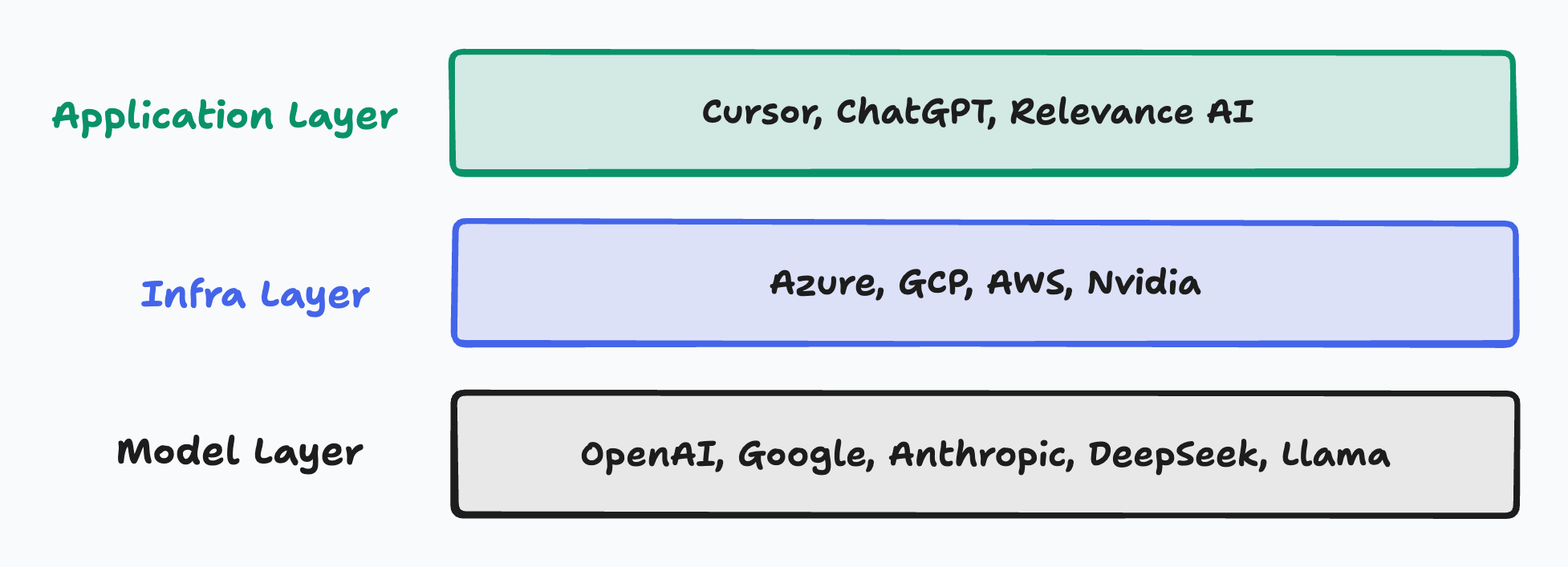
Three layers make the AI stack:
1. Application Layer- Product companies turn capabilities into user value
2. Infrastructure Layer - Infra companies make capabilities accessible and scalable
3. Model Layer - Model companies create foundational capabilities
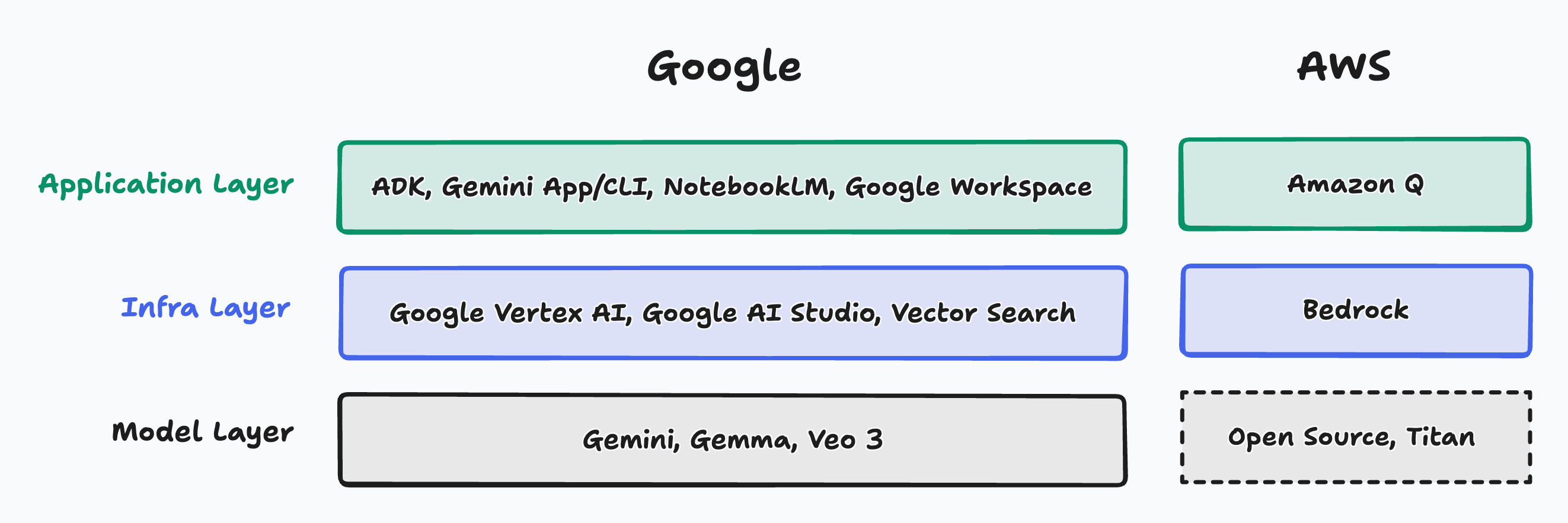
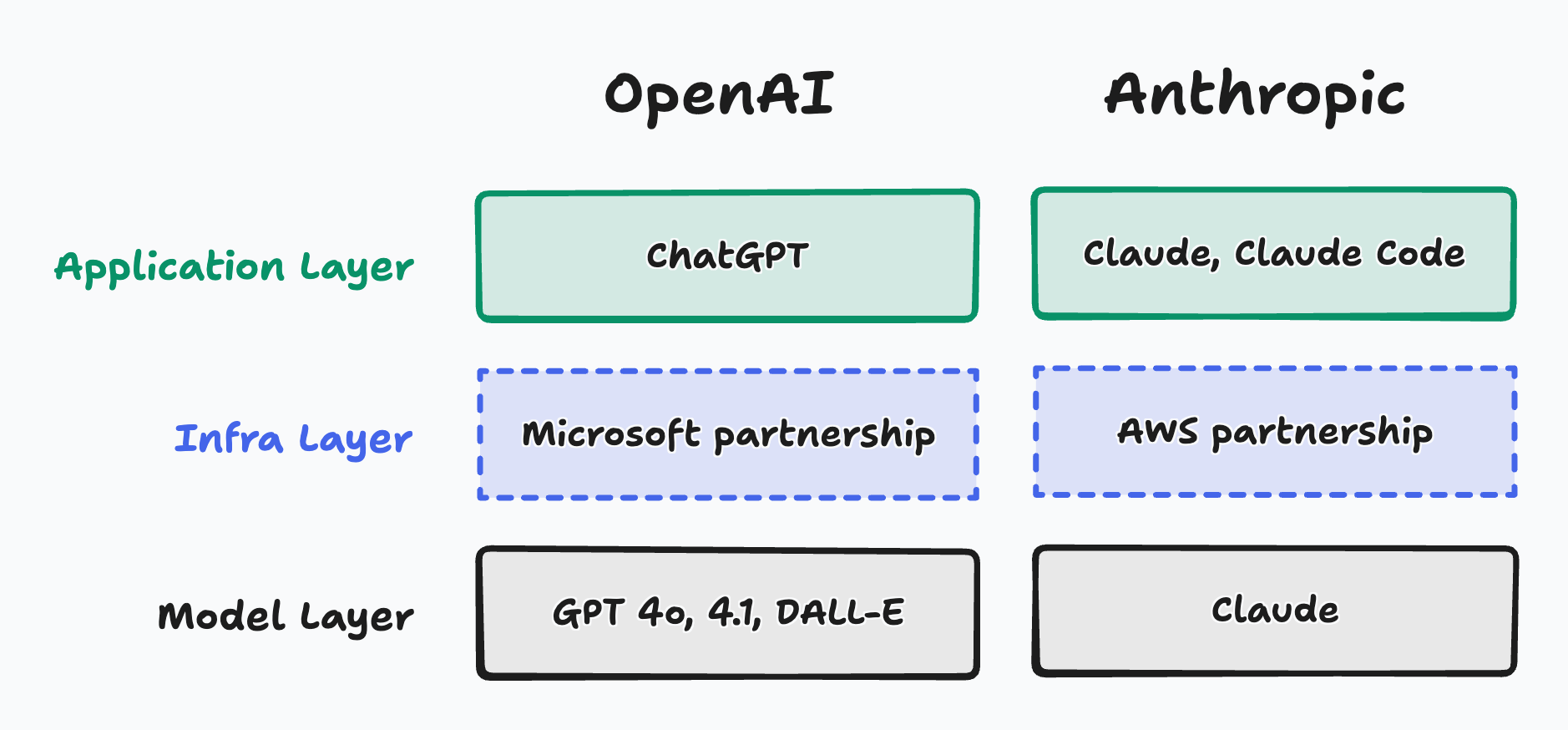
Big Tech companies and AI startups may focus on all three layers
whereas AI Engineering in other companies focuses on the **Application** layer.
## Companies
**Product Companies** build user-facing apps. Deploy fast. Iterate based on feedback. Examples include [Cursor](https://www.cursor.sh/), [GitHub Copilot](https://copilot.github.com/), [Devin AI](https://www.cognition-labs.com/devin), [Lindy](https://www.lindy.ai/), [Cursor](https://www.cursor.com/), and [Bland](https://www.bland.ai/).
**Infrastructure Companies** provide tools for product teams. B2B focus. Built for scale and reliability.
* **Inference Providers** serve models through APIs. [OpenRouter](https://openrouter.ai/), [Together AI](https://www.together.ai/), [Cohere](https://cohere.com/), [Amazon Bedrock](https://aws.amazon.com/bedrock/), [Hugging Face](https://huggingface.co/), [Google Vertex AI](https://cloud.google.com/vertex-ai), [Replicate](https://replicate.com/), [Fireworks AI](https://fireworks.ai/).
* **Database Providers** serve AI-optimised retrieval. [Pinecone](https://www.pinecone.io/), [Weaviate](https://weaviate.io/), [Qdrant](https://qdrant.tech/), [Chroma](https://www.trychroma.com/).
* **Observability Providers** monitor and evaluate performance. [Galileo](https://galileo.ai/), [Phoenix](https://phoenix.arize.com/), [Langfuse](https://langfuse.com/), [Opik](https://www.comet.com/site/products/opik/), [LangSmith](https://www.langchain.com/langsmith).
* Evaluation Frameworks assess various aspects of LLM performance, such as correctness, faithfulness, and safety, using metrics like answer relevancy, hallucination detection, and task completion
**Model Companies** create foundation models. [Google](https://deepmind.google/models/gemini/), [Meta](https://www.llama.com/), [Anthropic](https://www.anthropic.com/), [OpenAI](https://openai.com/), [Mistral AI](https://mistral.ai/), [xAI](https://x.ai/), [Stability AI](https://stability.ai/).